
Backhaul along US-54 toward Las Cruces
Multi-duct pull under frontage with NMDOT MOT — hand holes at every conflict before the bit tracks.
Alamogordo, NM · Otero County
Fiber conduit boring along Alamogordo US-54 and White Sands Boulevard — multi-duct HDD when trenching would cross gravel drives and shallow El Paso Electric stacks.
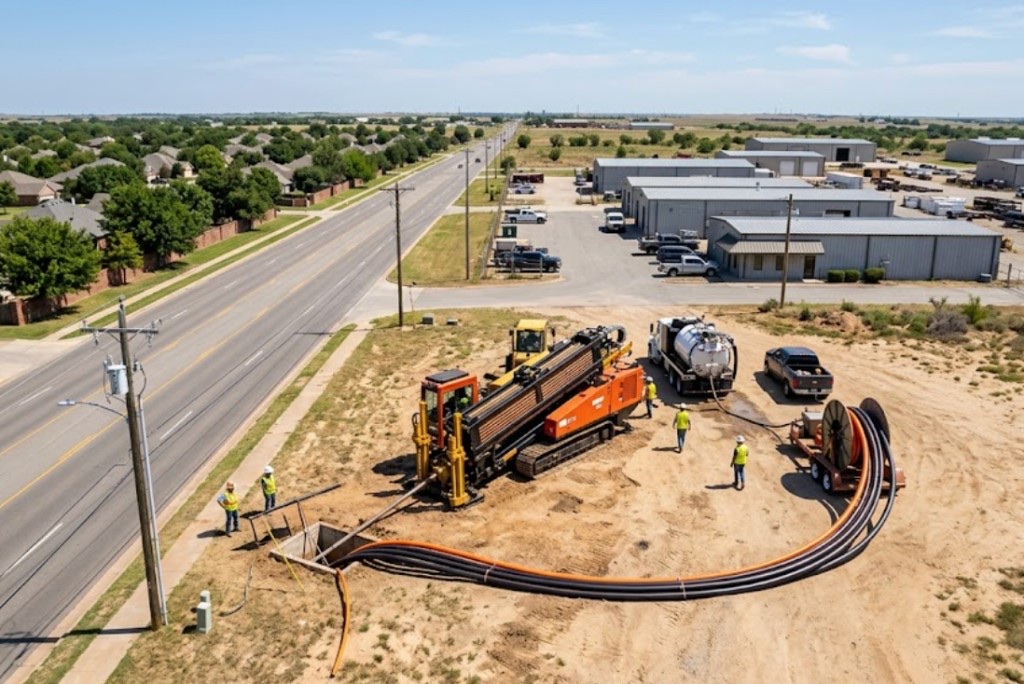
Fiber optic boring in Alamogordo supports carrier backhaul, enterprise rings, and small-cell feeds without tearing up White Sands frontage and suburban gravel drives. Vault-to-vault paths are drilled when contractor schedules cannot absorb city restoration fights.
US-54, White Sands Boulevard, and First Street stack shallow power, gas, and irrigation in the first few feet — remark tickets and pothole programs are standard on Alamogordo fiber bores. Multi-duct HDPE bundles pull when bend radius and reamed diameter are engineered.
Directional boring in Alamogordo for telecom often runs parallel to NMDOT relocations — franchise fees, traffic control, and duct count are separated in quotes so splicing crews can mobilize on vault coordinates.
Real Otero County angles — not generic statewide copy.
Multi-duct pull under frontage with NMDOT MOT — hand holes at every conflict before the bit tracks.
Short curb-to-pole bore with power and fiber coordinated — compact rig on tight ROW.
Duct between buildings under rock mulch — HOA restoration favors trenchless through common areas.
Night bore under asphalt to avoid daytime access loss — city ROW permits layered on 811.
Alamogordo fiber bores start with franchise and ROW clarity — then 811 tickets and potholes along the vault path. Ream diameter sized for duct count; pullback tension watched on long US-54 shots. As-builts feed splicing crews; NMDOT detail when path crosses state ROW.
Otero County basin floors carry gypsum-rich sand, caliche lenses, and desert alluvium — Sacramento foothill cobbles and military-adjacent grading debris change mud programs block to block.
Alamogordo bores encounter gypsum-rich sandy fill in the Tularosa Basin floor with caliche lenses between 2 and 6 feet on many residential parcels. Sacramento foothill-adjacent shots hit cobble and fractured bedrock that stall reaming without mud program adjustment. Arroyo channels off the mountains carry flash-flood debris after monsoon storms — potholing catches buried rubble before pits are sized. We do not assume Las Cruces valley sand models apply in basin desert gypsum.
Tularosa Basin heat, spring wind, and summer monsoons drive Alamogordo bore schedules — dust storms and flash-flood arroyos off the Sacramentos are built into quotes.
Summer heat above 100°F affects crew safety and fluid performance on exposed basin pads. Monsoon cloudbursts fill arroyos and soften ROW from July through September — entry pit work may wait for dry windows. Spring wind complicates cage handling on open US-54 sites. Winter cold at basin elevation slows morning startup but rarely stops work — we communicate when dry conditions matter for gypsum-heavy pits.
City of Alamogordo Community Development, Otero County ROW, NMDOT District 1 on US-54 and US-70, Holloman AFB coordination on adjacent parcels, and El Paso Electric agreements apply on many alignments.
City of Alamogordo Community Development governs street cuts, driveway removals, and flood-control work along municipal arroyos. Otero County ROW applies on unincorporated parcels toward Tularosa and La Luz. NMDOT District 1 controls US-54, US-70, and state highway bores — MOT plans are common on White Sands Boulevard frontage. Holloman AFB coordination may apply on parcels near base boundaries and military utility corridors. El Paso Electric agreements govern electric-adjacent paths in southern New Mexico.
Fiber schedules die on White Sands restoration — boring keeps corridors moving. Open trench may fit greenfield pads before paving. Parallel gas requires code separation and operator clearance.
Duct count, length, hardscape at vaults, traffic control, and city franchise fees.
You share plans or describe the problem; we confirm alignment, depth, access, and which trenchless method fits New Mexico soils.
New Mexico 811 ticket filed; two business days minimum before pits open unless your permit path differs. We pothole where marks conflict.
Bore plan, NMDOT or city ROW permits, railroad agreements, and crossing engineering when the path leaves private property.
Compact spread for tight Santa Fe lots; larger HDD for I-25 or I-40 relocations — matched to length and diameter.
Steered pilot on design line, ream passes sized for your pipe or casing, fluid program tuned for caliche or adobe clay.
HDPE fusion, steel casing, or multi-duct bundle pulled with tension and bend-radius monitoring.
Pressure test, mandrel, or survey records for owners, inspectors, and operators as spec requires.
Compact pits, replace gravel or hardscape per scope, leave 811 ticket and locate map in your project file.
Duct count, length, hardscape at vaults, traffic control, and franchise fees drive price. Send vault plan for scoped estimate.
Engineered from duct OD and reamed hole — we do not overload pulls.
Yes — locates, separation, and clearance agreements. No work on incomplete marks.
When NMDOT permits approve the path — lead times often exceed drill duration.
24/7 — Emergency dispatch statewide. Tell us entry, exit, pipe size, and county — a bore specialist calls back with cost drivers, not a flat rate.
Scope your alignment
Step 1 of 2 — path, pipe, and city first